Planning an event involves dozens of decisions, but determining how many Security Guards you need can be one of the most important. Too little security may leave entrances, crowds, parking areas, or restricted spaces inadequately monitored. On the other hand, assigning personnel without considering the actual risks can result in resources being placed where they provide limited value.
There is no universal guard-to-guest ratio that works for every event. A private corporate dinner for 200 guests has very different security requirements from a concert with the same attendance. Similarly, an outdoor festival, sporting event, wedding, convention, and product launch each present different challenges.
For event organizers in Houston, TX and throughout Texas, determining appropriate security staffing starts with understanding the event itself. Attendance matters, but so do the venue, entrances, alcohol service, event hours, crowd characteristics, valuable assets, VIPs, parking arrangements, and emergency procedures.
Professional Event Security Guards can then be strategically assigned to the areas where they provide the most value.
Why There Is No Single Security Guard Ratio
It may be tempting to use a simple formula such as one guard for every certain number of attendees. While attendance is useful when estimating staffing, relying on headcount alone overlooks many important considerations.
Imagine two events with 500 attendees.
The first is an invitation-only corporate conference held during the day at a controlled indoor venue. The second is an evening outdoor concert serving alcohol with several entrances and a large parking area.
Although attendance is identical, the second event could require considerably more security coverage because there are additional areas and potential risks to manage.
Instead of asking only, “How many guests are coming?” organizers should ask, “What security responsibilities need to be covered?”
Start With Expected Attendance
Guest count remains a useful starting point because larger crowds generally create more responsibilities.
As attendance increases, organizers may need additional officers for:
- Entrances
- Exits
- Crowd monitoring
- Restricted areas
- Parking lots
- VIP locations
- Vendor areas
- Emergency response support
A small private gathering may require only limited coverage, while a large public event could require teams positioned throughout the property.
Attendance should therefore be considered alongside the venue and event format rather than used as the sole staffing calculation.
Count Your Entrances and Exits
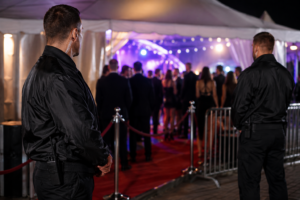
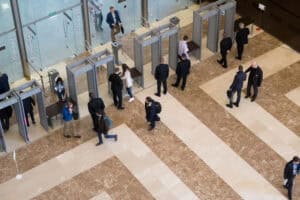
One of the most practical ways to begin determining how many Security Guards you need is to examine access points.
If an event has one controlled entrance, access management may be relatively straightforward. If there are several public entrances, employee entrances, vendor gates, VIP access points, and loading areas, more personnel may be necessary.
Depending on the event, officers may be responsible for:
- Checking tickets
- Confirming credentials
- Monitoring guest lists
- Inspecting bags according to event policies
- Directing attendees
- Monitoring restricted entry points
American Guard Security’s event services include access-point monitoring and crowd-related security, and the company says its event strategies are customized around individual event requirements.
Having a clear venue map makes it easier to identify how many locations require dedicated personnel.
Consider the Type of Event
Event type can significantly affect staffing.
Corporate Events
Business conferences, award ceremonies, networking functions, and company celebrations may require access control, VIP protection, and general monitoring.
Concerts and Entertainment Events
Concerts can involve dense crowds, performers, backstage areas, merchandise, multiple entrances, and heightened activity before and after performances.
Weddings and Private Celebrations
Private gatherings may primarily require guest verification, parking monitoring, and assistance if disturbances occur.
Festivals and Community Events
Outdoor events often cover large areas and may have several entrances, vendors, stages, and activity zones.
Sporting Events
Sporting events may require crowd monitoring, access management, and attention to interactions between groups of spectators.
The more complex the event, the more important it becomes to assign personnel according to specific responsibilities.
Does the Event Serve Alcohol?
Alcohol service can change an event’s security needs.
Events where alcohol is available may have a greater potential for disputes, impaired judgment, or guests requiring assistance. That does not automatically mean an event needs a large security team, but it should be considered during the risk assessment.
Organizers should consider:
- Number of bars
- Hours of alcohol service
- Expected attendance
- Age requirements
- Venue policies
- Closing procedures
Strategically positioning Event Security Guards near high-traffic locations can provide additional support without making guests feel that they are constantly being watched.
Evaluate the Venue Size and Layout
Two events with identical attendance can require different staffing simply because of their layouts.
A single ballroom is easier to monitor than a property containing several buildings, outdoor areas, parking lots, and multiple entrances.
Walk through the venue and identify:
- Public entrances
- Emergency exits
- Restrooms
- Stages
- Bars
- VIP rooms
- Backstage locations
- Equipment storage
- Parking areas
- Loading zones
- Areas with limited visibility
Each location does not necessarily need a dedicated guard, but understanding the layout allows a security provider to establish effective positions and patrol routes.
Think About Crowd Density, Not Just Attendance
Total attendance tells you how many people are at the event. Crowd density tells you where they are concentrated.
A 1,000-person event spread across a large outdoor property may present different challenges from 1,000 people gathered around one stage.
High-density locations may develop around:
- Entrances
- Stages
- Food vendors
- Bars
- Restrooms
- Popular attractions
- Merchandise areas
- Transportation pickup points
Professional security personnel can monitor these areas and assist with orderly movement when congestion develops.
American Guard Security identifies crowd control as part of its event security capabilities and states that event personnel are trained to remain professional while helping maintain attendee safety.
Don’t Forget Parking and Exterior Areas
When calculating security staffing, organizers sometimes focus entirely on what happens inside the venue.
Guests, however, experience the event from the moment they arrive.
Large parking areas, pedestrian routes, rideshare locations, exterior gates, and loading zones may require additional monitoring.
For events in Houston, TX, organizers should evaluate whether personnel are needed to observe parking areas, exterior entrances, or other locations away from the primary gathering space.
American Guard Security also offers mobile patrol services that can check exterior entrances, gates, safety hazards, trespassers, and other property concerns.
Consider VIPs and Restricted Areas
Some events require additional security because certain people or locations need dedicated protection.
Examples include:
- Performers
- Executives
- Public figures
- Private guests
- Backstage areas
- Cash-handling locations
- Equipment rooms
- Control rooms
Assigning a guard to a VIP or restricted area means that officer may not be available for general crowd monitoring.
Organizers should therefore calculate these assignments separately instead of assuming all officers can move freely throughout the venue.
Factor in Vendors and Employees
Guests are only part of the event population.
Depending on the event, there may also be:
- Caterers
- Entertainers
- Production crews
- Photographers
- Delivery drivers
- Cleaning personnel
- Temporary workers
- Exhibitors
- Contractors
Large events may have hundreds of people working behind the scenes.
Vendor entrances and loading zones may require security coverage before the public event even begins. Staffing schedules should therefore account for setup and breakdown periods in addition to guest hours.
Decide Whether You Need Armed or Unarmed Guards
Not every event requires armed security.
Many gatherings can be appropriately supported by unarmed officers responsible for access control, visible deterrence, crowd observation, guest assistance, and reporting.
Events with elevated or identified risks may require a different security approach.
American Guard Security provides both armed and unarmed security officers for events, allowing coverage to be adapted to varying risk levels and event environments.
The decision should be based on an assessment of actual risks rather than automatically assuming that one option is appropriate for every event.
Plan for Arrival and Departure Surges
An event may operate smoothly for several hours but experience its greatest security challenges during a relatively short period.
Arrival and departure times can create:
- Long lines
- Traffic congestion
- Crowded entrances
- Rideshare backups
- Pedestrian conflicts
- Confusion around parking
Some events may benefit from scheduling additional personnel during these peak periods rather than maintaining identical staffing throughout the entire day.
Flexible scheduling can place security resources where they are needed most.
Prepare for Emergency Coverage
Security staffing should also account for what happens when an officer must leave a normal position to address an incident.
If every guard is assigned to a fixed entrance, who responds when assistance is required elsewhere?
Larger events may benefit from supervisors or roaming personnel who can respond without leaving critical access points unattended.
Security planning should also address communication procedures, evacuation responsibilities, emergency exits, and coordination with venue personnel or first responders.
American Guard Security states that its event services include advance planning, threat assessment, issue prevention, crowd control, and crisis response when necessary.
Questions to Answer Before Finalizing Staffing
Rather than relying on an arbitrary number, event organizers should review several questions with their security provider:
- How many people are expected?
- How many entrances require monitoring?
- Is the event public or invitation-only?
- Will alcohol be served?
- Are there VIPs?
- Are there restricted areas?
- How large is the venue?
- Is parking security necessary?
- Are there multiple buildings or activity areas?
- What are the busiest arrival and departure times?
- Are valuable assets or equipment present?
- Does the event have previous security concerns?
- What emergency procedures are established?
Once these questions are answered, determining appropriate staffing becomes much more practical.
Why Choose American Guard Security for Event Protection?
American Guard Security provides professional event security services in Houston, TX and serves events ranging from private gatherings to larger public functions. Its event security offerings include access monitoring, crowd control, armed and unarmed personnel, and customized security planning.
The company also provides uniformed security officers, mobile patrol, video surveillance support, and specialized security options that can be incorporated depending on the event’s needs.
Rather than simply selecting a number of guards based on attendance, a customized approach allows organizers to consider the complete event environment and assign personnel strategically.
Final Thoughts
So, how many Security Guards does your event really need?
The answer depends on much more than guest count. Event type, venue size, entrances, crowd density, alcohol service, VIPs, parking areas, restricted spaces, operating hours, and identified risks all influence staffing.
Professional Event Security Guards should be placed according to responsibilities rather than scattered throughout a venue without a clear plan. The goal is to have appropriate coverage at important locations while maintaining flexibility to respond when conditions change.
For organizers planning events in Houston, TX or elsewhere in Texas, working with an experienced security provider can help determine an appropriate staffing strategy before guests arrive. With careful planning, security becomes an integrated part of the event—supporting safety, organization, and a positive experience from arrival through departure.